A missing tooth is more than a visible space in a smile. Depending on its location, it can change how comfortably you chew, affect speech, and place different pressures on the surrounding teeth. Over time, nearby teeth may move toward an open space, which can complicate the bite. The good news for Rockville residents is that there are several proven ways to replace missing teeth. For people considering dental implants Rockville, MD, State Of The Art Dental Group provides information about surgical implant placement and restorations for single missing teeth, multiple teeth, and full arches in Rockville. Its implant-focused approach includes digital imaging, treatment planning, bone grafting when appropriate, and options such as implant-supported bridges and dentures, helping patients evaluate the foundation behind a replacement plan rather than selecting a solution based on appearance alone.
Key Takeaways
- Replacing missing teeth can help support comfortable chewing, speech, bite alignment, and the appearance of a smile.
- Dental implants provide a root-based replacement that can support an individual crown, bridge, or denture, depending on the number of missing teeth.
- Traditional dental bridges offer a fixed alternative without implant surgery but may require reshaping neighboring teeth for support.
- Partial and full dentures can replace several or all missing teeth and may suit patients who prefer a removable option or want to manage initial costs.
- Gum health, jawbone condition, medical history, smoking, and teeth grinding can influence treatment eligibility and planning.
- Treatment costs and timelines vary based on the restoration, preparatory procedures, healing needs, and long-term maintenance.
- Rockville patients should compare comfort, cleaning requirements, expected upkeep, and overall costs with a dentist before choosing a tooth replacement option.
Start With The Tooth, The Gap, And The Surrounding Teeth
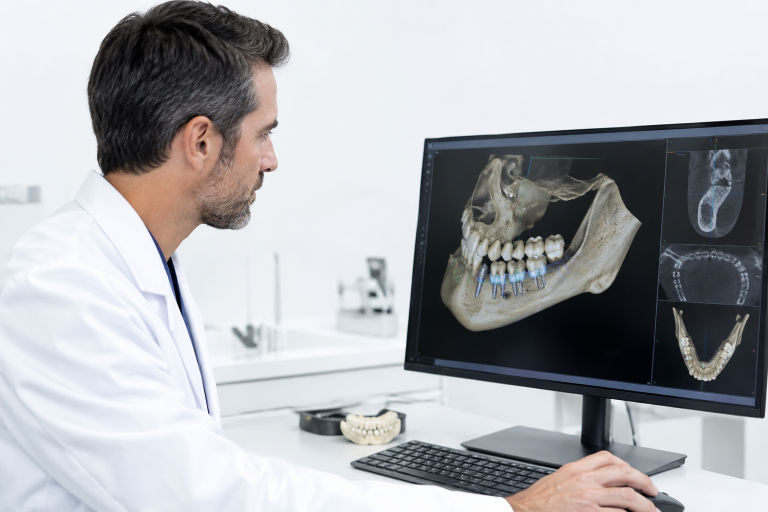
The first question is not always how to replace a tooth. It is whether the tooth can be saved. When a damaged tooth has a reasonable prognosis with restorative treatment, preserving it may be worth discussing before extraction. If replacement is needed, a dentist evaluates the number of missing teeth, where the space sits in the mouth, the condition of neighboring teeth, and how the upper and lower teeth meet. Digital X-rays and other imaging can help show bone levels, roots, infection, and structures not visible during a routine examination. Gum disease, tooth grinding, smoking, certain medical conditions, and oral hygiene habits can also influence which option is practical and how treatment should be sequenced. It also helps to understand the basic parts of a dental implant. An implant restoration generally includes a post placed in the jawbone, an abutment that connects components, and a visible crown, bridge, or denture.
Dental Implants: A Root-Based Replacement
A dental implant is designed to support a replacement tooth from within the jawbone. For a single missing tooth, an implant may support a crown without requiring adjacent teeth to serve as anchors. Multiple implants can also support a bridge or a restoration that replaces a full upper or lower arch.
Potential Advantages
- They can be fixed in place rather than removed for daily cleaning.
- They generally do not require reshaping otherwise healthy teeth next to the gap.
- They can support a crown, bridge, or denture, depending on the number of missing teeth.
- Because the implant post occupies the role of a tooth root, it can provide stimulation to the surrounding jawbone.
Implants also involve surgery and a healing process. Some patients need treatment for gum disease or a bone graft before placement. Temporary teeth may be available in selected cases, but timing depends on the extraction site, bone quality, bite forces, and the overall treatment plan.
Dental Bridges: A Fixed Option Without Implant Surgery
A traditional dental bridge replaces a missing tooth by attaching a replacement tooth between crowns on the teeth beside the gap. This approach may be a practical choice when adjacent teeth already need crowns or can provide strong support. Bridges can also replace several nearby teeth in appropriate situations. The principal trade-off is that supporting teeth may need to be reshaped for crowns. A bridge does not replace a tooth root beneath the missing area, and it requires specific hygiene tools or techniques to clean underneath the replacement tooth. Regular examinations matter because the supporting teeth and gums still need protection.
Dentures: A Removable Choice For Larger Gaps
Partial dentures replace some missing teeth, while full dentures replace all teeth in an upper or lower arch. They can be a useful option for people who need broad coverage, prefer to avoid surgery, or are working within a lower initial treatment budget. Because conventional dentures rest on the gums, their fit can change as the mouth changes over time. Movement, sore areas, and food collecting beneath the appliance are possible concerns. Implant-supported dentures can add retention and stability. Some are removable for cleaning, while others are fixed in place and maintained by a dental professional.
A Quick Comparison Of Your Main Options
- Placement: Implants are anchored in the jawbone. Traditional bridges are fixed to neighboring teeth. Dentures are usually removable.
- Surgery: Implant treatment generally requires surgery. Traditional bridges and conventional dentures usually do not.
- Nearby teeth: Implants can stand independently. Bridges may require reshaping supporting teeth. Dentures typically do not use teeth as permanent fixed anchors.
- Cleaning: Implants need brushing, flossing, and professional care. Bridges need cleaning below the replacement tooth. Dentures are removed and cleaned daily.
- Typical fit: Implants may suit people seeking a stable fixed solution. Bridges may suit a gap with appropriate neighboring teeth. Dentures may suit multiple missing teeth or full-arch tooth loss.
How Gums And Bone Shape The Decision
Healthy gums are important with every type of tooth replacement. Untreated gum disease can damage the tissues that support natural teeth and may affect the stability of a restoration. The National Institute of Dental and Craniofacial Research explains that gum disease can progress from early inflammation to more serious damage if left untreated. For implants, the amount and condition of bone at the site are especially important. Bone grafting may be recommended when there is not enough support for predictable implant placement. A dentist should also review medical history, medications, diabetes management, smoking, grinding habits, and healing concerns before recommending surgery.
Cost, Time, And Long-Term Value
An exact treatment cost requires an examination and written plan. Expenses can vary based on the number of teeth being replaced, extractions, imaging, grafting, sedation, the restoration material, laboratory work, insurance benefits, and future maintenance needs. Bridges may require fewer appointments than implants in many cases. Implant treatment often includes a healing period before the final crown, bridge, or denture is attached. Dentures can sometimes be made relatively quickly, but adjustments may be needed as tissues heal or fit changes. Compare the full picture, including comfort, cleaning, repairs, and expected replacement needs, not only the initial fee.
A Simple Decision Process
- Confirm the cause. Identify whether decay, injury, gum disease, or another problem led to tooth loss.
- Ask if the tooth can be saved. Review restorative possibilities before extraction when appropriate.
- Assess the foundation. Check gums, bone, bite forces, and neighboring teeth.
- Choose fixed or removable. Consider whether you want a restoration that stays in place or comes out for cleaning.
- Plan for daily care. Select an option you can clean consistently and maintain with regular visits.
Questions To Bring To Your Consultation
- Can the damaged tooth be saved?
- Which options fit the number and location of my missing teeth?
- Do I have enough bone for an implant, or would grafting be needed?
- Will I have a temporary tooth during treatment?
- How will each choice affect chewing, speech, and cleaning?
- What future maintenance, repairs, or replacement costs should I expect?
Choose The Option That Fits The Whole Picture
Implants, bridges, and dentures can each be appropriate solutions for patients in Rockville. The right answer depends on oral health, bone support, the location and number of missing teeth, budget, timeline, and personal preferences. A personalized examination turns a broad comparison into a plan that supports comfortable function and a confident smile.
Conclusion
Replacing missing teeth involves more than filling a visible gap. The right treatment should account for oral health, bone support, neighboring teeth, bite function, budget, and personal preferences. Dental implants, traditional bridges, and removable dentures each offer different benefits and considerations, so no single option is appropriate for everyone. Rockville residents considering tooth replacement can begin by discussing whether a damaged tooth can be saved, which solutions suit their needs, and whether additional procedures may be necessary. State Of The Art Dental Group provides information about implant placement and restoration options, including crowns, bridges, and dentures. A personalized examination and clear treatment plan can help patients understand their choices, prepare for the expected timeline and costs, and select an option they can maintain with daily care and regular dental visits.