
What does it take to stay innovative inside one of the world’s most influential technology companies for more than two decades?
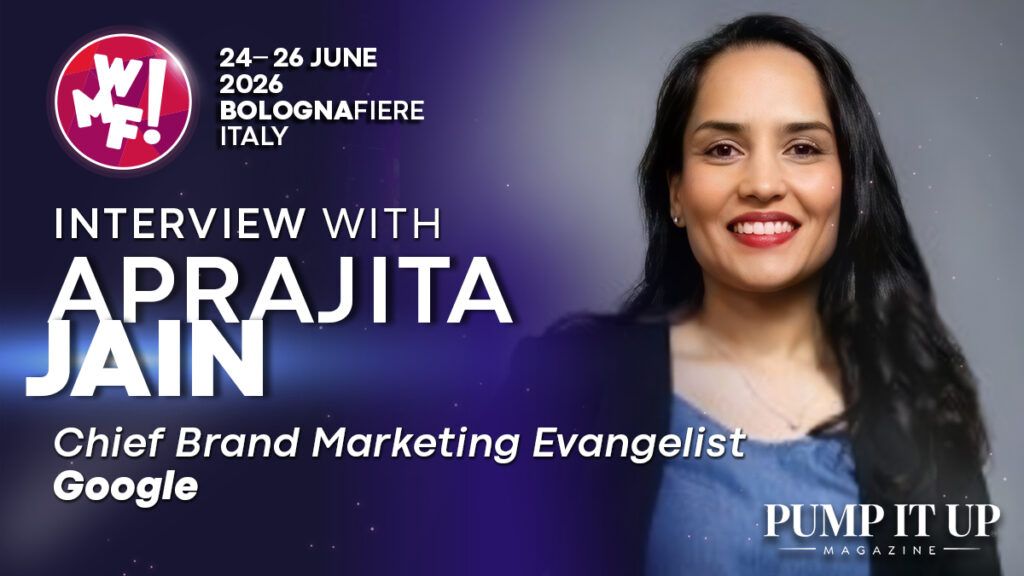
As part of our official WMF 2026 coverage, Pump It Up Magazine sits down with Aprajita Jain, Chief Brand Marketing Evangelist at Google, to discuss innovation, leadership, artificial intelligence, brand strategy, and the future of human creativity.
In this exclusive interview, Aprajita shares lessons from her 22-year journey at Google, explains why the traditional marketing funnel is collapsing, explores the rise of Brandformance, and reveals why original human thinking may become even more valuable in the age of AI.
From entrepreneurship and leadership to women in technology, wellness, and personal growth, her insights offer a powerful roadmap for marketers, business leaders, startups, and innovators navigating the next era of digital transformation.
Read more WMF 2026 interviews and event coverage:
https://www.pumpitupmagazine.com/wmf-2026-ai-business-digital-event/
EXCLUSIVE INTERVIEW
PIUM: Looking back on your 22 years at Google, what are the most important lessons you’ve learned about innovation, leadership, and staying relevant in a rapidly changing world?
Aprajita Jain: Ha! How much space do we have? I could probably write a book on these lessons alone, but let’s try to boil 22 years down to the essentials. 😉
The biggest thing I’ve learned is that relevance is a moving target. The second you think you’ve “arrived,” you’re already standing still while the world moves past you. After two decades here, I’m convinced that true innovation isn’t about being a fortune teller; it’s about building a culture that is comfortable with ambiguity.
When it comes to leadership, my philosophy is simple: stop managing tasks and start protecting your team’s mental bandwidth. Real leaders shouldn’t be traffic cops; they should be friction-fighters. We hire brilliant people at Google, and the best thing a leader can do is get out of their way and remove the barriers that prevent them from doing their best work.
And here’s a spicy take: to stay relevant, you have to be willing to destroy your own success before a competitor does it for you. If you aren’t actively cannibalizing your own best ideas, the market will do it for you – and it won’t be as polite about it. If you want to see how we respectfully bury our darlings at Google, check out killedbygoogle.com.
PIUM: Your WMF keynote is titled “Three Lessons from Two Decades Inside Google.” Can you give our readers a preview of one lesson that has had the biggest impact on your career?
Aprajita Jain: The lesson that’s been the North Star of my career is this: The Only Algorithm that Matters is Adaptability.
People often think working inside a major tech company is about mastering specific code or understanding a static formula for success. But formulas expire quickly. The most critical competitive advantage is maintaining a constant state of Beta – a willingness to experiment, learn, and fail fast before the market forces your hand. During the keynote, I will be breaking down how to build this specific muscle so that disruption becomes your tailwind instead of your threat.
PIUM: You often speak about the Brandformance Revolution. Why do you believe the traditional divide between brand marketing and performance marketing no longer works?
Aprajita Jain: The separation of brand and performance marketing is a relic of old organizational charts, not human behavior. For decades, companies split these budgets: one team focused on long-term “feeling” (brand) and another on immediate “clicking” (performance).
But guess what? Consumers don’t live in silos. They see an emotionally resonant video on YouTube and they want to act – now. We’re seeing this in our formats today; you can be moved by a creator’s story and, with two clicks, make a purchase without ever leaving the experience. The inspiration and the transaction have become one thing.
Brand building must drive measurable action, and performance tactics must respect the brand’s identity. If your performance ads look cheap, you ruin the brand. If your brand ads don’t move the needle, you’re just making expensive art. Brandformance is the acknowledgment that every touchpoint must do both jobs simultaneously.
PIUM: How is AI changing the way brands build trust, visibility, and meaningful customer relationships?
Aprajita Jain: AI is a massive equalizer for visibility, but it raises the bar exponentially for trust. Because anyone can now generate decent content at scale, visibility is no longer the ultimate prize. Trust is.
Brands cannot use AI to automate authenticity. If a customer feels like they are interacting with a sterile, algorithmic loop, the relationship is dead. I’d be lying if I said I haven’t seen some terrible ads created by AI that just killed my mojo for the brand. Haven’t you?
The brands that win with AI use it to handle the “heavy lifting” – the data, the logistics, the personalization – so their humans are free to do the “heavy feeling.” AI builds the engine; humans provide the empathy. That’s where the magic happens.
Related: Explore more insights on artificial intelligence and innovation:
https://www.pumpitupmagazine.com/cosmano-lombardo-wmf-2026-interview/
PIUM: What do you mean by “Marketing in the Collapsed Funnel,” and what should businesses be doing differently today?
Aprajita Jain: We used to treat marketing like a slow walk down a long staircase: Awareness, then Consideration, then finally Conversion. Today, that entire staircase has collapsed into a single step.
A consumer can discover a brand, research its credibility, and make a purchase decision within a 60-second window while watching a video or by simply entering a well-structured prompt into an AI chatbot. Businesses need to stop building fragmented campaigns that treat these steps as separate events. Your creative needs to be sharp enough to capture attention immediately, and your backend needs to be frictionless enough to close the deal on the spot. If you make a user jump through three hoops to buy what they just saw, you lose them to someone who shortened the distance between inspiration and transaction.
PIUM: In a world increasingly filled with AI-generated content, why do you believe original human insight and “Spicy Thinking” are becoming even more valuable?
Aprajita Jain: When everyone has access to the same AI models, the output inevitably starts to sound the same. We are facing a sea of corporate sameness – bland, optimized, safe content that satisfies an algorithm but bores a human.
“Spicy Thinking” is the only antidote to this mediocrity. It’s about having a sharp, maybe even slightly contrarian, point of view. I love a challenger mindset because it forces you to be curious and actually have a conversation worth having.
AI can synthesize existing knowledge beautifully, but it cannot generate a truly original, provocative insight based on human intuition and years of reading between the lines in senior client meetings. Original perspective is the only true differentiator left. If your opinion isn’t slightly polarizing, it’s invisible.
PIUM: What advice would you give entrepreneurs, startups, and marketers looking to build memorable brands in the AI era?
Aprajita Jain: First, don’t lead with your technology or your product; lead with your point of view. Startups often fall into the trap of listing features or bragging about their AI integration. No one cares. Customers care about how you see the world and how you solve their specific frustrations.
Think about it: when we moved from desktop emails to mobile, we didn’t sign every message with “Sent from my amazing mobile device” just to brag about the tech. What mattered was the message. AI is the same – let it be the pipe, don’t make it the water.
Second, focus heavily on building a distinct brand identity early on. Because execution is now cheap and fast thanks to AI, your competitors can copy your features in a weekend. What they cannot copy is the unique relationship and emotional connection your brand has built with its audience.
Looking for more business and entrepreneurship insights?
https://www.pumpitupmagazine.com/business/
PIUM: Throughout your career, what principles have helped you successfully navigate change and remain innovative in such a fast-moving industry?
Aprajita Jain: First, staying close to the client’s reality. It’s easy to get caught up in internal company theories. I stay grounded by constantly talking to our largest partners, understanding their actual business pressures, and bringing those unfiltered insights back into my work. A large part of that also includes understanding your stakeholders’ stakeholders. For example, recently I was headed to a meeting with the leadership team of Kia Motors. Serendipitously, the Uber that drove me there was a Kia! So I got into a conversation with the driver and for a full 17 minutes he gave the best download on how he feels about the brand, how much it has changed over the past 8 years he has been an auto enthusiast and why he loves it so much. Keeping your eyes and ears open in the most unexpected places can sometimes teach you a lot and give you new ideas.
Second, at our company we live by the philosophy of “launch and iterate.” In a fast-moving industry, perfection is the enemy of progress. If you wait until an idea, a strategy, or a project is 100% flawless before putting it out into the world, you’ve already missed the window. You have to be willing to ship the 80% version, see how the market reacts, and refine it in real-time based on actual data rather than boardroom theories.
Lastly, I don’t take myself too seriously. Ego is the absolute death of innovation. When you take yourself too seriously, you become defensive, you stop listening to feedback, and you get too precious about your past successes. You have to be willing to laugh at your own missteps, admit when an experiment failed, and pivot without treating it like a personal tragedy. Staying light on your feet requires a healthy dose of humility.
PIUM: As someone who has built a successful global career in technology and marketing, what advice would you give to women aspiring to lead, innovate, and make an impact in the tech industry?
Aprajita Jain: Don’t try to fit into the corporate mold; break it and build a better one. As a young brown woman, I’ve often been in rooms where no one looked like me or shared my background. It’s intimidating, but I learned early that credibility is built the moment you open your mouth, not by checking a box of who people expected to see.
Own your expertise and speak with conviction. Don’t dilute your “spicy” takes just to make others comfortable. Deliver undeniable value, and remember: your distinct perspective isn’t a hurdle to overcome – it is your greatest competitive advantage.
PIUM: At Pump It Up Magazine, we also focus on mindset, wellness, and personal growth. What habits or practices have helped you stay energized, resilient, and creative throughout your career?
Aprajita Jain: I am at my absolute best when I am in a flow state, and for me, that comes from stepping outside my own bubble. I find immense energy in learning something completely new and immersing myself in other people’s worlds, whether that’s through traveling to a new culture or diving into a great book. I also love a good, intellectually stimulating conversation that has absolutely nothing to do with marketing, technology, or work.
But my ultimate “me time” is strength training. No phone, no notifications, no distractions. For that hour, I am just present in the effort. It’s the best part of my day because it gives me the mental resilience to show up fully everywhere else.
Keep in mind: You cannot think outside the box if you are too exhausted to see the box.
Related Interview:
Oleg Reksha discusses AI, leadership, innovation, and human-centered technology:
PIUM: Looking ahead, what excites you most about the future of AI, marketing, innovation, and human creativity?
Paradoxically, I’m excited about the renaissance of human creativity that AI is forcing. For too long, marketers were bogged down in the mechanics – spreadsheets, formatting, manual optimizations. AI is taking that mundane work off our plates and forcing us back into the realm of pure strategy, imagination, and storytelling.
The future belongs to the big thinkers, the provocateurs, and those who know how to connect deeply with human nature. We are finally getting the time back to do what humans do best: think deeply.
Here is a prediction I’d bet on: the brands/companies/organizations/systems that win will be the ones that help us spend more time OFF our devices and in real life. In an increasingly automated world, the only thing people will pay a premium for is a deep, authentic, human experience.
Inspired by Aprajita’s perspective?
Follow her on LinkedIn for thought-provoking insights on Brandformance, AI, innovation, leadership, and the future of marketing.
👉 Connect with Aprajita Jain: LinkedIn profile link
Aprajita Jain’s perspective is a powerful reminder that while technology continues to evolve at an unprecedented pace, the future still belongs to those who can think differently, lead with purpose, and connect authentically with people.
Her insights on adaptability, Brandformance, AI, creativity, and leadership demonstrate that innovation is not simply about adopting new tools—it’s about developing the mindset to continuously learn, evolve, and challenge conventional thinking.
As businesses prepare for the next wave of transformation, one message stands out clearly: AI may accelerate execution, but human creativity, empathy, and original thinking remain the ultimate competitive advantage.
Whether you’re a startup founder, marketer, entrepreneur, or aspiring leader, Aprajita’s advice offers valuable lessons for building meaningful brands and thriving in an increasingly AI-powered world.
Want to hear Aprajita Jain speak live?
Join thousands of innovators, entrepreneurs, marketers, and technology leaders at WMF 2026, where Aprajita will present her keynote, “Three Lessons from Two Decades Inside Google.”
Learn more about the program and speakers:
https://en.wemakefuture.it/next/schedule/
Enjoyed this interview?
Explore more exclusive WMF 2026 interviews, AI insights, startup stories, innovation trends, and thought leadership features on Pump It Up Magazine.
Follow Pump It Up Magazine for more interviews with global leaders shaping the future of AI, marketing, entrepreneurship, creativity, and innovation.
👉 https://www.pumpitupmagazine.com
Frequently Asked Questions
Who is Aprajita Jain?
Aprajita Jain is Chief Brand Marketing Evangelist at Google and a featured speaker at WMF 2026.
What will Aprajita Jain discuss at WMF 2026?
She will present “Three Lessons from Two Decades Inside Google” and share insights on AI, Brandformance, innovation, and marketing strategy.
What is Brandformance?
Brandformance combines brand marketing and performance marketing into a unified strategy that drives both awareness and measurable business results.
How is AI changing marketing?
According to Aprajita Jain, AI is transforming customer engagement, content creation, personalization, and brand visibility while making human creativity more valuable than ever.