
Why Peer Networks and Verification Matter in the Modern Gig Economy
In today’s dynamic job market, the freelance economy thrives, offering unparalleled flexibility and access to specialized talent. However, this decentralized nature often presents a unique challenge: how can employers confidently verify freelance experience? When traditional work history checks fall short, the power of professional networks becomes indispensable.
Many freelance roles, especially those outside formal platforms or short-term gigs, can be difficult for potential employers to thoroughly vet. We understand this creates a significant hurdle for both job seekers showcasing their skills and companies seeking trustworthy professionals. This guide will explore how leveraging personal and professional networks provides a robust solution.
We will delve into why peer networks and referrals are vital in the modern gig economy. We will cover proven strategies for securing freelance job referrals and how to effectively navigate the verification challenges of referred work. We’ll also share best practices for documenting and showcasing these projects, ensuring your valuable freelance experience is recognized. For many, finding and managing these opportunities is simplified when a dedicated hub centralizes freelance job referrals, connecting talent with trusted opportunities.
The landscape of labor has undergone a profound transformation. As more professionals embrace independent contracting and businesses seek flexible staffing solutions, the traditional paradigms of employment verification are being reshaped. This shift towards a highly mobile workforce necessitates new approaches to client vetting and establishing trust.
The Rise of Independent Contracting
The gig economy, a term encompassing project-based work and short-term engagements, has seen significant growth globally, including regions like Canada, where it’s gaining traction as individuals explore flexible income options. For businesses, this model offers numerous advantages: the ability to quickly fill temporary roles, access specialized skills without long-term commitments, and scale operations efficiently. For workers, it provides the freedom to manage schedules, diversify income through multiple gigs, and pursue creative endeavors.
By October 2026, independent workers constitute a substantial portion of the workforce, with statistics from a few years prior indicating that over a third of U.S. employees identified as independent contractors. In the U.S., these individuals are often referred to as “1099 employees” (though the correct term is independent contractor), signifying their distinct tax status from traditional W-2 employees. This distinction means they are responsible for their own taxes and benefits, operating with a high degree of autonomy. While this flexibility is beneficial, it also means that their work history isn’t typically tracked or verified in the same way as a full-time employee’s, posing a challenge for future employers.
Overcoming the Work Experience Trust Gap
The informal nature of much freelance work creates a “trust gap” for potential employers. Traditional background screening processes typically rely on consistent, verifiable employment history, often confirmed by an HR department. Most companies with an HR department in the U.S., for instance, will only verify dates of employment, job title, and sometimes rehire eligibility. For a freelancer, especially one engaged in numerous short-term gigs or off-platform projects, this kind of formal verification is frequently impossible.
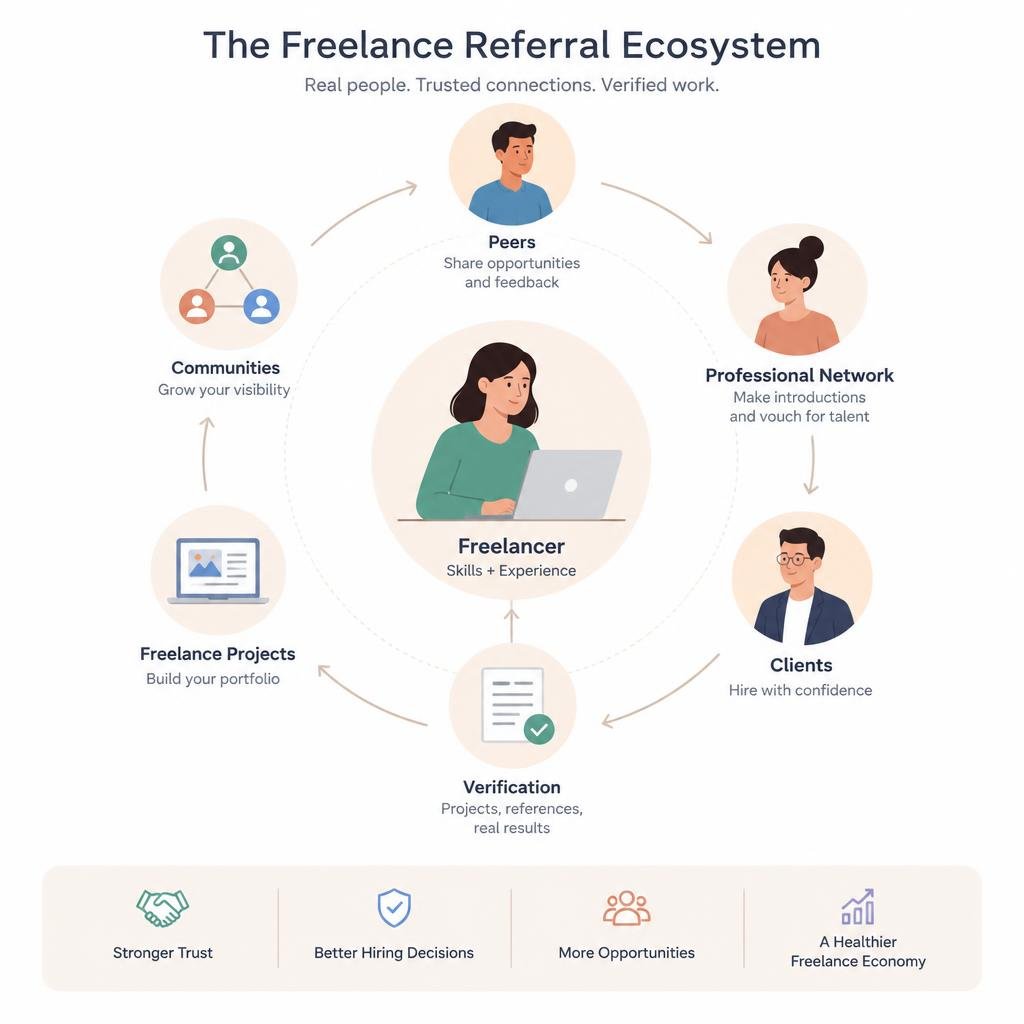
Employers might struggle to verify freelance experience because there’s no central HR department to call, client confidentiality agreements (NDAs) may prevent direct contact, or the sheer volume and brevity of projects make individual verification impractical. This is where the power of networks becomes evident. Instead of relying on a formal background check that might not yield results for freelance roles, employers often turn to reputation management, portfolio validation, and client references. A strong referral from a trusted source within an industry can bridge this trust gap, acting as a powerful endorsement of a freelancer’s skills and reliability where traditional verification methods fall short.
Proven Strategies to Secure Freelance Job Referrals
Building a successful freelance career in October 2026 often hinges on effective relationship building and professional outreach. Securing job referrals is a cornerstone of this strategy, allowing freelancers to tap into a pipeline of opportunities that might never be publicly advertised.
How to Ask Past Clients for Freelance Job Referrals
Your past clients are your most valuable advocates. A satisfied client is not only likely to rehire you but also to recommend your services to their network. The key is to make it easy for them to do so.
- Timing is everything: The best time to ask for a referral is immediately after a successful project completion, when your work is fresh in their mind, and they’ve expressed satisfaction.
- Make it easy: Instead of a vague request, offer to provide a short blurb or bullet points outlining your services and the value you delivered. This gives them concrete language to use when speaking to potential referrers.
- Be specific: If you know a client has connections in a particular industry or with a specific type of project you’re interested in, you can gently inquire if they know anyone who might benefit from your expertise.
- Always follow up: Thank them for their time and any referrals they provide, regardless of the outcome. Maintaining a positive relationship ensures they’ll think of you again in the future.
A strong client referral serves as an invaluable form of “verification” for future employers, offering a personal endorsement that traditional background checks often cannot provide for independent contractors.
Cultivating Peer Networks for Freelance Job Referrals
Beyond clients, your fellow freelancers and industry peers are a rich source of referrals. They understand the nuances of freelance work, can vouch for your skills, and often have overflow work they need to subcontract.
- Specialized communities: Actively participate in online forums, social media groups, and local meetups dedicated to your niche. Share your expertise, offer help, and build genuine connections. When peers know your capabilities, they’re more likely to refer you.
- Capacity sharing: Freelancers often face periods of high demand or projects that exceed their individual capacity. By networking with others, you can become a trusted resource for subcontracting opportunities. Conversely, you can also refer work to your peers when you’re overbooked, fostering a reciprocal relationship.
- Dedicated hubs: For many freelancers, discovering and managing these opportunities is significantly streamlined when a dedicated hub effectively centralizes freelance job referrals. Such platforms can connect you with a broader network of peers and clients, making it easier to find and be found for referred projects.
Engaging Industry Communities and Professional Groups
Expanding your network to include broader industry communities and professional associations can unlock a wealth of referral opportunities. These groups offer visibility and allow you to demonstrate your expertise to a wider audience.
- Alumni associations: If you’re a graduate of a university or specialized program, your alumni network can be a powerful resource. Many alumni are in positions to hire or refer freelancers.
- Virtual meetups and conferences: Participate in online events, webinars, and virtual conferences relevant to your field. These are excellent opportunities to learn, share insights, and connect with potential collaborators or clients.
- Industry discussions: Engage thoughtfully in online discussions on platforms like LinkedIn or specialized forums. By offering valuable perspectives, you establish yourself as an expert, increasing your “social proof” and the likelihood of being considered for referred work.
- Volunteering: Offering your skills pro bono to a non-profit or community project can expand your network and provide tangible examples of your work, which can lead to paid referrals down the line.

Navigating Verification Challenges with Unadvertised and Referred Work
While referrals are a powerful source of freelance work, they often come with unique verification challenges. Many referred projects, particularly word-of-mouth engagements, fall outside traditional employment structures, making formal credential confirmation difficult for future employers. This section addresses the “what jobs employers can’t verify freelance” dilemma head-on.
Managing Word-of-Mouth and Off-Platform Projects
A significant portion of freelance work, especially for experienced professionals, originates from unadvertised roles and direct agreements. These projects, while often lucrative and fulfilling, typically lack the formal documentation found on public freelance platforms. This informal nature is precisely why they can be difficult for a third-party employer to verify. There’s no platform record, no public reviews, and often, client privacy considerations might limit the information they are willing to share.
Consider the distinctions between direct client referrals and public freelance platforms:
Criteria Direct Client Referrals Public Freelance Platforms (e.g., Upwork, Fiverr) Acquisition Speed Slower initial build-up, but faster once network is strong Faster initial access, but competition can be high Commission Fees None Typically 5-20% of earnings Trust Factors High (personal connection, direct endorsement) Moderate (platform reviews, ratings, dispute resolution) Verification Ease Low (informal, relies on personal references) Moderate (platform records of completed projects, payments) The table highlights that while direct referrals offer higher trust through personal endorsement and no fees, they present a lower ease of verification for an external party. This means freelancers engaging in such projects must be proactive in documenting their work.
Legal and Compliance Considerations for Contractors
Employers often face legal and ethical considerations when attempting to verify freelance work, which contributes to the difficulty in formal verification. Client confidentiality, often enforced by non-disclosure agreements (NDAs), can legally prevent past clients from discussing project specifics or even confirming a freelancer’s engagement. This is a primary reason why many freelance jobs are inherently difficult to verify in a traditional sense.
Furthermore, companies themselves may be hesitant to share details due to privacy laws (like Canada’s PIPEDA or the U.S.’s FCRA, which governs background checks) or concerns about liability. As research suggests, most companies in the U.S. with an HR department will only confirm basic details like employment dates and rehire eligibility for former employees, and large organizations may even refuse to share any details due to policies designed to protect employee privacy and minimize legal risk.
While it is legal to run background checks on contractors with their consent, the scope of what can be verified is often limited. Background checks typically rely on consistent work history and formal records, which gig employees may not provide. This means that for many freelance roles, especially short-term gigs or those with informal contracts, employers simply cannot obtain the same level of verification as they would for a traditional employee. The onus then falls on the freelancer to present their experience credibly and proactively.
Best Practices for Documenting and Showcasing Referral Projects
Given the inherent challenges employers face in verifying informal freelance work, it becomes crucial for job seekers to proactively document and showcase their referral projects. This strategy transforms potentially unverified experience into a compelling narrative of skill, reliability, and impact.
Structuring Portfolios to Validate Experience
A well-structured portfolio is a freelancer’s most powerful verification tool. It provides tangible proof of work and allows you to control the narrative around your experience.
- Focus on measurable outcomes: Instead of just listing tasks, quantify your achievements. Did you increase client engagement by X%? Reduce costs by Y? Complete a project Z days ahead of schedule? These metrics speak volumes.
- Include testimonials: Obtain written or video testimonials from satisfied clients, especially those who referred you. These serve as direct endorsements and add a layer of credibility that can substitute for formal verification. Always get permission before publishing them.
- Showcase visual deliverables: For creative or technical roles, visual examples of your work (designs, code snippets, writing samples, project screenshots) are essential.
- Develop case studies: For larger or more complex projects, create concise case studies that outline the client’s challenge, your approach, the solutions implemented, and the results achieved. This demonstrates your problem-solving abilities and strategic thinking.
- Keep it current: Regularly update your portfolio with your latest and most impactful work.
An interactive digital portfolio, complete with client case studies and testimonials, offers a dynamic and verifiable presentation of your skills and accomplishments.

Maintaining Tax Records and Invoices as Proof of Work
Beyond the public-facing portfolio, maintaining meticulous financial and project records is a crucial best practice for documenting your freelance career. These documents serve as concrete, formal proof of your engagements.
- Invoices: Keep copies of all invoices issued to clients. Each invoice should detail the services provided, the dates of service, and the amount charged. This demonstrates a professional engagement and a financial transaction.
- 1099-NEC forms (U.S.): If you are an independent contractor in the U.S. and a client pays you $600 or more in a calendar year, they are required to issue you a Form 1099-NEC. These forms are formal tax documents that confirm income earned from specific clients, providing undeniable proof of your freelance engagements.
- Scope documentation and contracts: While not always available for every informal gig, having signed contracts or clear statements of work for projects, even email agreements outlining the scope, deliverables, and payment terms, can be invaluable.
- Payment receipts and accounting ledgers: Maintain clear records of all payments received and expenses incurred. This not only aids in tax preparation but also provides an auditable trail of your freelance business activities.
These financial records, particularly 1099-NEC forms and detailed invoices, offer a robust form of indirect verification that can be presented to potential employers or background check services, especially when direct client contact is not feasible due to confidentiality.

Frequently Asked Questions About Freelance Referrals
Navigating the freelance world, especially when it comes to referrals and verification, can raise several questions. Here, we address some common concerns to help you manage your career effectively.
How do background checks handle informal freelance referrals?
For informal freelance referrals or projects that lack traditional employment records, background checks operate differently. It’s very unlikely that a company will ask for “proof” of minor freelance work. Most background check services will not be able to directly “verify” an informal freelance engagement in the same way they would a W-2 job, as there’s no HR department to contact. However, they may look for other indicators. This could include requesting copies of your 1099 forms (if applicable), asking for client references (which you would provide with consent), or looking for evidence of your registered business if you operate as one. For high-stakes roles, like those in strategy consulting firms, direct proof of minor freelance work is rarely requested, though interviewers might inquire about the nature of the work. The burden often falls on the freelancer to provide compelling documentation or strong, articulate answers about their experience.
Can freelance referral work be included on a traditional resume?
Absolutely. Freelance referral work is valid work experience and should be included on your resume. It effectively fills employment gaps, showcases your initiative, and demonstrates a range of transferable skills. When adding it, clearly label it as “Freelance,” “Contract,” or “Independent Consultant.” You can list individual clients or group similar projects under a single “Freelance” heading, especially if you had many short-term engagements. For each entry, describe your role, the services provided, and, most importantly, quantify your achievements. For example, instead of “Managed social media,” write “Increased client’s social media engagement by 25% over six months.” Consider using a hybrid resume format that highlights both your chronological experience and your key skills, which is particularly effective for freelancers.
What is the most effective way to incentivize peer referrals?
Incentivizing peer referrals is about fostering a culture of reciprocity and mutual benefit. The most effective ways include:
- Reciprocal sharing: Be generous with your own referrals. When you help a peer find work, they are far more likely to think of you when they have an opportunity or overflow project.
- Finder’s fees or gifts: For significant referrals that lead to paid work, consider offering a small finder’s fee or a thoughtful gift as a token of appreciation. This formalizes the incentive and encourages future referrals.
- Networking etiquette: Always be professional, reliable, and responsive. Your reputation within your peer network is paramount. If you’re known as someone who delivers high-quality work and is easy to collaborate with, peers will be confident in referring you.
- Visibility: Make sure your network knows what kind of work you’re looking for and what your current availability is. The clearer you are about your needs, the easier it is for others to refer suitable opportunities.
Conclusion
In the evolving landscape of the gig economy, where traditional employment verification can be a significant hurdle for freelance work, the power of networks emerges as an indispensable tool for career longevity and growth. We’ve explored how a robust network of past clients, industry peers, and professional communities can provide the crucial trust signals that formal background checks often miss for independent contractors.
By proactively cultivating these relationships, diligently documenting your projects with portfolios and financial records, and articulating your value effectively, you can transform the challenge of unverified freelance work into a testament to your professionalism and skill. In October 2026, success in freelancing is not just about the work you do, but the relationships you build and the trust you inspire. Embrace relationship management, foster peer trust, and commit to continuous growth, and your freelance career will thrive.