
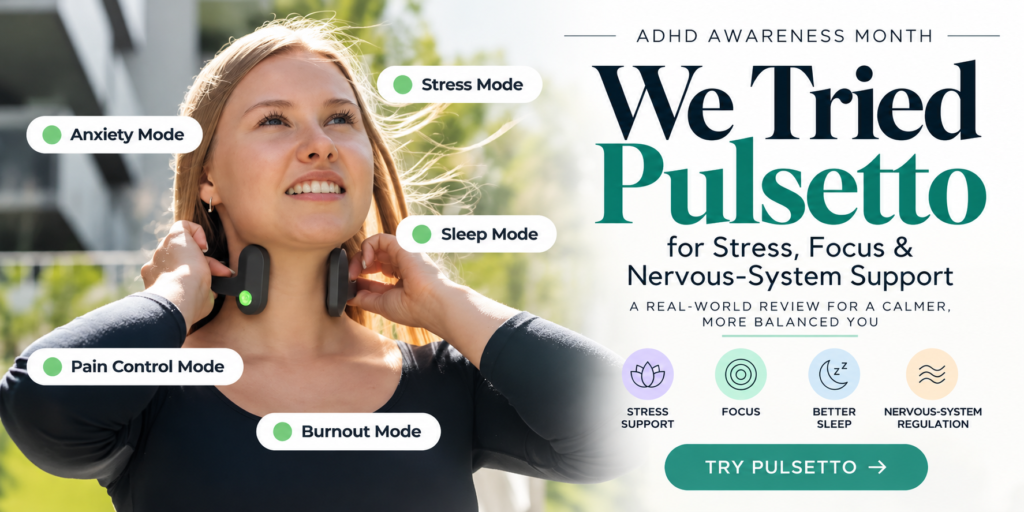
October is ADHD Awareness Month, and while conversations often center on attention and concentration, ADHD can also overlap with everyday challenges such as feeling overwhelmed, difficulty winding down, disrupted sleep, and trouble shifting from one task or emotional state to another.
That made us curious about Pulsetto, a wearable wellness device designed to stimulate the vagus nerve through the neck.
Pulsetto is not an ADHD treatment, and the company classifies it as a general wellness device rather than a medical device. It is not intended to diagnose, treat, cure, or prevent ADHD or any other medical condition. Pulsetto Affiliates
What interested us instead was a simpler question:
Could a short nervous-system reset make it easier to feel calmer, more settled, and ready to focus?
So we tried it.
What Is Pulsetto?
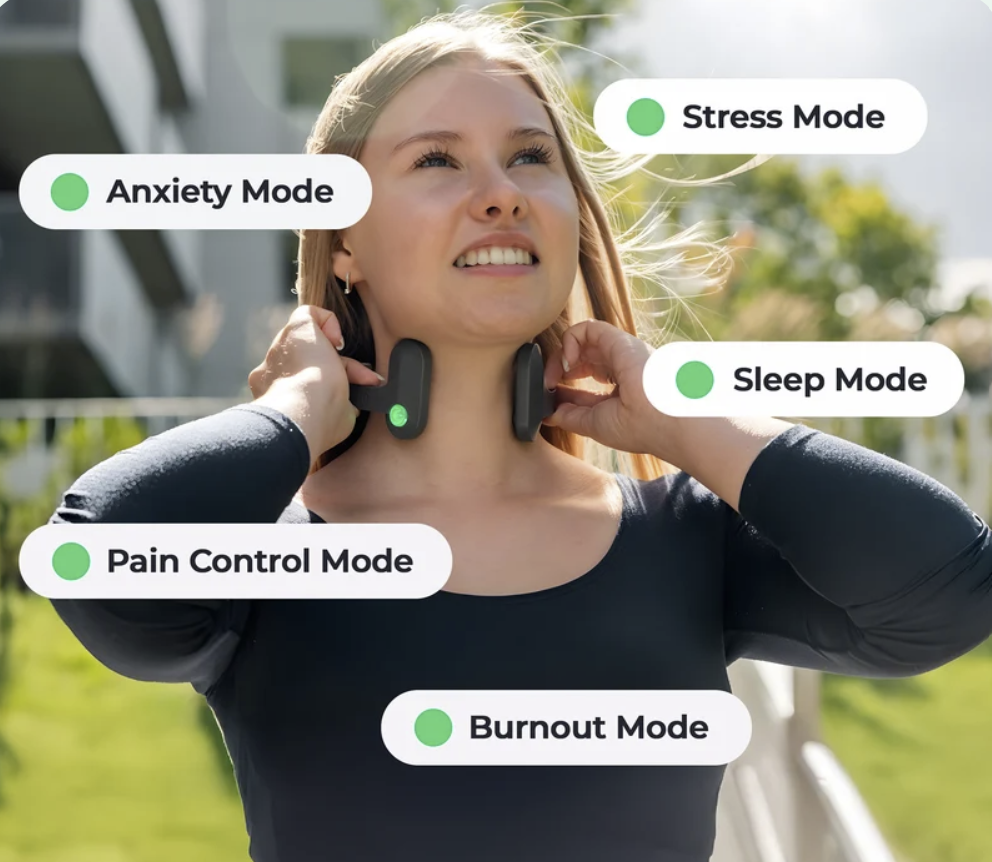
Pulsetto is a small wearable device that sits around the neck and delivers gentle electrical stimulation through the skin in the area of the vagus nerve.
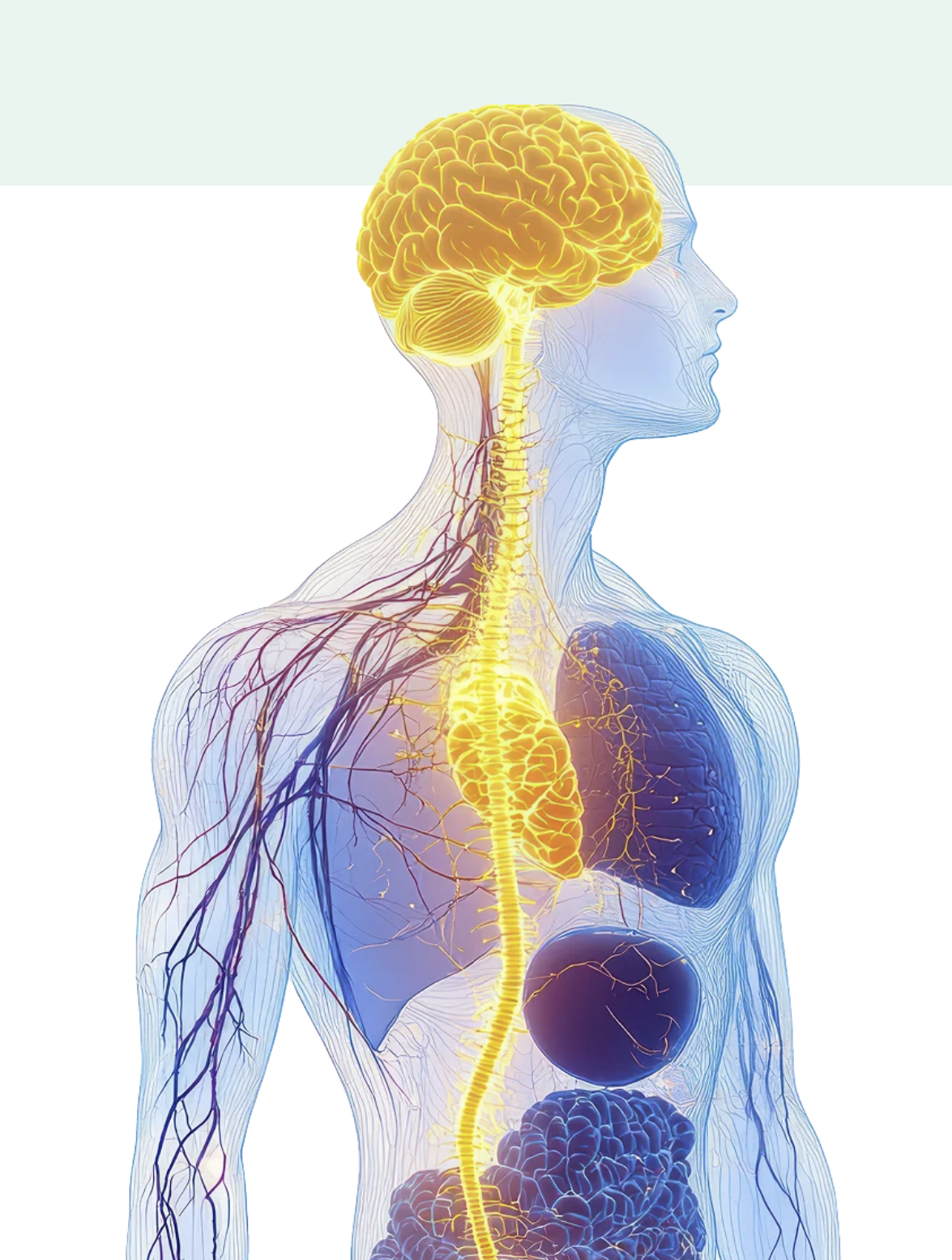
The vagus nerve plays an important role in the parasympathetic nervous system—the part of the nervous system involved in rest, recovery, and regulation.
Pulsetto is controlled through a smartphone app and offers guided programs aimed at areas such as stress, sleep, calm, focus, and relaxation. The company describes the technology as non-invasive cervical vagus nerve stimulation, or VNS. Pulsetto
Sessions can be quite short, with some of Pulsetto’s current programs designed to take only a few minutes. Pulsetto
That immediately made the device interesting from a practical standpoint.
Because sometimes the wellness routine you actually use is more valuable than the elaborate one you keep promising yourself you’ll start next Monday.
Our First Impression
Pulsetto looks more like a piece of modern wellness technology than a traditional therapeutic device.
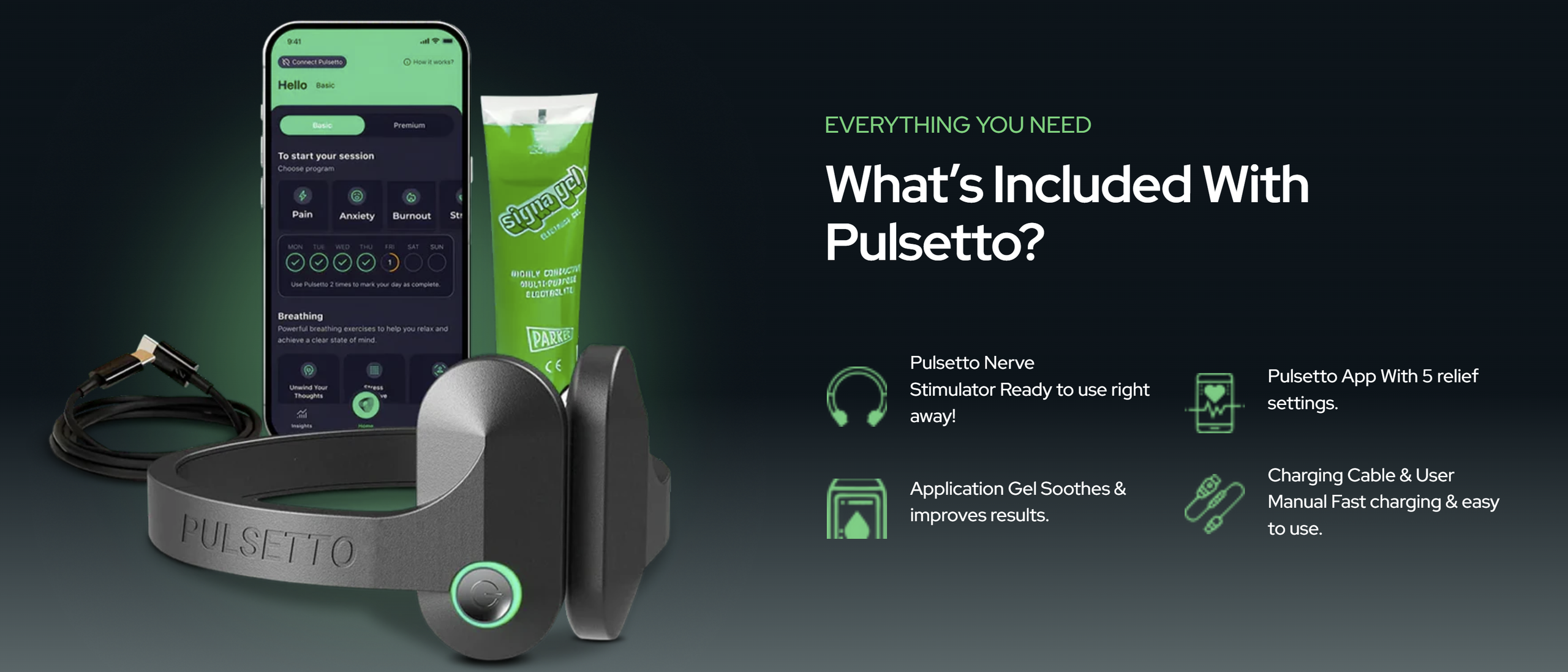
You place it around your neck, use conductive gel where the electrodes make contact with the skin, connect through the app, choose your program, and adjust the stimulation intensity.
The sensation is noticeable.
Depending on the intensity, it can feel like light pulsing, tingling, or tiny rhythmic contractions around the neck area. Pulsetto itself notes that users may experience sensations such as gentle pulsing or pins-and-needles during use. Pulsetto Affiliates
It took a little experimentation to find a level that felt noticeable without becoming distracting.
And that is probably the first thing we’d tell a new user:
You do not need to turn the intensity all the way up.
The goal isn’t to prove how tough you are. Start comfortably and adjust gradually.
Why We Tried It During ADHD Awareness Month
There’s an important distinction here.
Pulsetto isn’t designed to “fix ADHD.”
But focus doesn’t exist in isolation.
Think about how difficult it is to concentrate when you’re stressed, overstimulated, exhausted, or mentally jumping between ten unfinished things at once.
Pulsetto’s own stress-focused materials make a similar connection, noting that stress can affect mood and concentration and positioning nervous-system regulation as a way of supporting a calmer baseline. Pulsetto
That’s the angle that made sense to us.
Rather than asking whether a device could suddenly turn someone into a productivity machine, we were more interested in whether it could become a transition ritual.
Something you use before work.
After a stressful meeting.
During an afternoon reset.
Or before bed when your brain still thinks it’s 2 p.m.
Trying the Focus Setting
The Focus program was naturally the first one we wanted to explore.
But here’s what surprised us: the experience isn’t like caffeine.
There’s no sudden “Let’s answer 47 emails!” feeling.
Instead, Pulsetto’s approach is more about reducing some of the nervous-system noise surrounding the task.
That distinction matters.
For someone who already feels overstimulated, another stimulant-like sensation isn’t necessarily what they’re looking for.
A short Pulsetto session felt more like deliberately creating a break between what just happened and what you’re about to do next.
That can be useful before sitting down to write, work, organize something, or tackle a task you’ve been avoiding.
The Stress Program May Be the Bigger Story
Interestingly, the Stress setting may ultimately be one of Pulsetto’s most appealing features.
Stress and focus are deeply intertwined in everyday life.
You’ve probably experienced it:
You have something important to finish.
You know exactly what needs to be done.
But instead of starting, you’re mentally bouncing between the task, your phone, another idea, something you forgot yesterday, and the fact that you’re now annoyed with yourself for not starting.
Adding a short physical ritual can interrupt that loop.
Pulsetto markets its device specifically around supporting relaxation and activating the body’s parasympathetic response. Pulsetto
We wouldn’t describe the experience as a magic “off switch.”
But having a dedicated few minutes where you’re intentionally doing nothing except slowing down can itself be valuable—and the stimulation gives that ritual a physical component.
And Then There’s Sleep
Anyone who has ever been exhausted all day and suddenly wide awake the moment their head touches the pillow understands why sleep deserves its own section.
Pulsetto includes sleep-oriented programs and positions vagus nerve stimulation as a tool for helping users shift into a calmer state before bedtime. Pulsetto
We particularly like the concept of using it as part of a consistent wind-down routine:
dim the lights,
put the phone away,
use Pulsetto,
then go to bed.
Simple.
Because good wellness technology shouldn’t necessarily give you more things to obsess over.
Sometimes it should help you do less.
What We Liked
The biggest advantage of Pulsetto is convenience.
Sessions are short.
The device is hands-free.
There are different programs depending on what you’re trying to accomplish.
And unlike routines that require 30 minutes of perfect silence, yoga equipment, or becoming someone who inexplicably wakes up at 5 a.m. every day, this can realistically fit between normal activities.
We also appreciate that Pulsetto feels like a tool you can integrate rather than an entire lifestyle you have to adopt.
What We’d Keep in Mind
Pulsetto won’t feel the same for everyone.
Some people may enjoy the tingling sensation immediately, while others may need time to adjust.
You’ll also need conductive gel, your phone, and the app to get the full experience.
And most importantly, this should be thought of as a wellness tool—not medical treatment.
Pulsetto lists several situations where the device should not be used or where medical guidance may be appropriate, including certain implanted electronic devices, some heart conditions, seizure history, pregnancy, and some neck-related medical circumstances. Pulsetto Affiliates
If you have a medical condition or any uncertainty about whether electrical vagus nerve stimulation is appropriate for you, speak with your healthcare provider before using it.
So, Is Pulsetto Worth Trying?
What we find most interesting about Pulsetto isn’t the promise of becoming endlessly productive.
It’s the opposite.
It’s the idea that sometimes improving your ability to focus starts by giving your nervous system permission to slow down first.
During ADHD Awareness Month, that’s a conversation worth having.
Attention isn’t just about forcing yourself to concentrate harder.
Stress matters.
Sleep matters.
Overstimulation matters.
Transitions matter.
And building small routines that help you shift from one state into another can be surprisingly powerful.
Pulsetto won’t replace appropriate ADHD care, medication, therapy, sleep habits, or professional support.
But as a wellness tool for creating a few intentional minutes of calm between the chaos of everyday life?
That’s where we think it becomes interesting.
Want to Try Pulsetto?
Explore Pulsetto here:
Try Pulsetto →
Frequently Asked Questions About Pulsetto
Is Pulsetto designed to treat ADHD?
No. Pulsetto is a wellness device designed to support relaxation, stress management, sleep, focus, and nervous-system regulation. It is not intended to diagnose, treat, cure, or prevent ADHD.
How does Pulsetto work?
Pulsetto is worn around the neck and uses gentle electrical stimulation to target the area of the vagus nerve, a major nerve that connects the brain with organs throughout the body and plays an important role in the parasympathetic nervous system — the system involved in rest, relaxation, and recovery.
When stress keeps you feeling tense, overstimulated, or “wired,” Pulsetto is designed to provide non-invasive vagus nerve stimulation that may help encourage a calmer physiological state.
Through the Pulsetto app, users can choose programs for stress, focus, relaxation, and sleep, then adjust the stimulation intensity to a comfortable level. Some sessions take only a few minutes, making it easy to use during a stressful moment, before focused work, or as part of a bedtime routine.
Pulsetto is a wellness device and should not be considered a treatment for ADHD, anxiety, or other medical conditions.
Can Pulsetto help with focus?
Pulsetto includes a Focus program designed to support a calmer state that may make it easier to concentrate. Individual experiences can vary.
What does Pulsetto feel like?
The device creates a gentle electrical stimulation around the neck. Depending on the intensity, you may notice tingling, pulsing, or light muscle sensations.
How long does a Pulsetto session take?
Sessions are generally short and can fit easily into a daily routine, whether you use Pulsetto before work, during a stressful moment, or before bed.
Can I use Pulsetto before sleeping?
Yes. Pulsetto offers sleep and relaxation programs intended to help users wind down and prepare for rest.
Is Pulsetto safe for everyone?
No. People with certain implanted electronic devices, heart conditions, seizure disorders, pregnancy, or other medical conditions should review Pulsetto’s safety guidance and speak with a healthcare professional before use.
Do you need an app to use Pulsetto?
Pulsetto works with its mobile app, where users can select programs, control sessions, and adjust stimulation intensity.
Where can I buy Pulsetto?
You can learn more and purchase Pulsetto through our affiliate link:
This article is for informational purposes only and is not medical advice. Pulsetto is a general wellness device and is not intended to diagnose, treat, cure, or prevent ADHD or any other medical condition.
Affiliate Disclosure: This article contains affiliate links. If you make a purchase through one of our links, Pump It Up Magazine may earn a commission at no additional cost to you.