

Choosing business internet is about more than finding the highest advertised download speed. A dependable plan should support cloud software, video conferencing, card terminals, backups, guest Wi-Fi, and the number of employees who need to work at once. This list compares leading national providers based on published pricing, available speed tiers, upload performance, connection technology, data policies, contract flexibility, backup options, security tools, and business-focused support.
Every provider below has a useful role, but the best choice still depends on the exact business address. Fiber, cable, fixed wireless, and backup options can differ substantially by location, so confirm available plans before placing an order.
Table of Contents
1. Verizon Business Internet: Best Overall For Flexible Connectivity
Why It’s #1
Verizon takes the top position because it gives businesses several practical ways to get online: Fios fiber, 5G Business Internet, LTE, and backup connectivity. That flexibility matters for companies with different locations, changing bandwidth needs, or limited access to wired infrastructure. The business internet Verizon lineup starts with the 300 Mbps Fios service at $69 per month, with 500 Mbps, 1 Gig, and 2 Gig options also available in qualifying areas.
Fios is the standout service for offices that routinely upload large files, use cloud platforms, run video meetings, or maintain off-site backups. Its symmetrical upload and download speeds and unlimited data on Fios plans make it especially attractive for accounting firms, medical offices, agencies, and professional service businesses. Verizon also offers static IP options, phone and mobile bundles, and backup internet services.
- Fios speed tiers range from 300 Mbps to 2 Gbps in available markets.
- Fiber plans provide symmetrical upload and download speeds.
- Fios plans include unlimited data.
- 5G and LTE options can simplify deployment where fiber is unavailable.
- Fiber availability is concentrated in parts of the Northeast and Mid-Atlantic.
Verizon is not the fiber provider with the broadest footprint, and wireless performance naturally varies by address and network conditions. Still, its unusually broad mix of fiber, 5G, LTE, backup, voice, and mobile options makes it the strongest all-around choice for businesses that need room to adapt.
2. AT&T Business: Best For Multi-Gig Fiber Speeds
Why It’s On The List
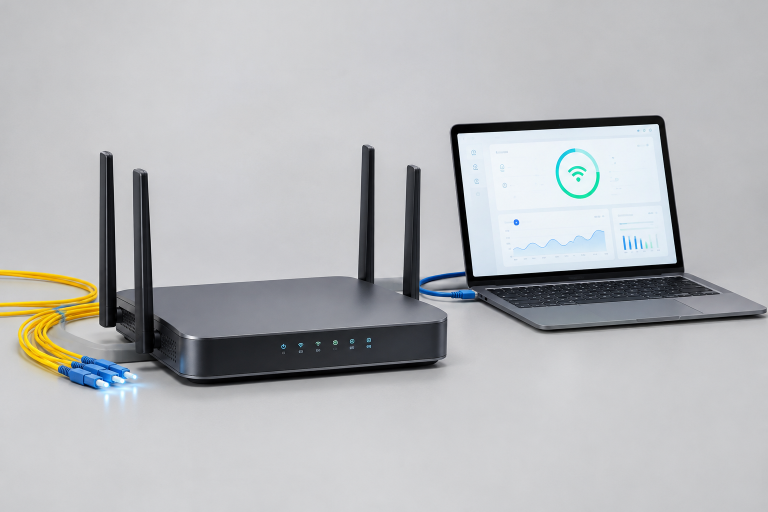
AT&T Business is an excellent choice for companies that prioritize high-capacity fiber. AT&T Business Fiber offers equal upload and download speeds, no data caps, no annual contract on listed fiber plans, and speed options from 300Mbps to 5 GIG. Its 300 Mbps plan is advertised at $60 per month, while its 5 GIG plan is designed for organizations with substantial cloud, collaboration, and data transfer demands.
- Business Fiber plans begin at 300Mbps.
- Maximum advertised service reaches 5 GIG.
- Fiber plans include equal upload and download speeds.
- Online orders include free installation where available.
- Eligible 1 GIG-and-higher plans can include 5G internet backup.
AT&T is particularly compelling for software teams, architecture firms, media businesses, and online retailers that handle large uploads. It ranks just below Verizon here because Verizon combines strong fiber capabilities with a broader mix of fixed wireless and LTE business connectivity choices.
3. Comcast Business: Best For Scalable Cable Internet And Security
Why It’s On The List
Comcast Business is a practical contender for small businesses that want several speed tiers, business bundles, and integrated network security. Its published internet options include 300Mbps, 500Mbps, 1.25Gbps, and 2Gbps plans, while Dedicated Internet over fiber can reach up to 10Gbps for qualifying small-business customers.
- Standard business internet starts at up to 300 Mbps.
- Higher tiers reach up to 2Gbps.
- Dedicated fiber internet can reach up to 10Gbps.
- SecurityEdge provides foundational protection against known malicious websites.
- Internet can be combined with mobile, voice, Wi-Fi, and video services.
Comcast Business is a strong fit for restaurants, storefronts, and offices that need fast downloads and want network security built into their provider relationship. Standard cable upload speeds may not match fiber at every tier, but the range of business services remains a major advantage.
4. Spectrum Business: Best For No-Contract Service
Why It’s On The List
Spectrum Business stands out for straightforward, flexible service. Its plans have no data caps and no long-term contracts, making it appealing to startups, seasonal businesses, and growing offices that do not want a lengthy commitment. Published speed options include 500 Mbps, 750 Mbps, 1 Gig, and 2 Gig services in select markets.
- Plans have no data caps or annual contracts.
- Speed tiers reach up to 2Gbps in select areas.
- Business support is available 24/7/365.
- Optional static IPs and wireless backup are available.
- Internet can be bundled with phone, mobile, and TV services.
Spectrum is a sensible option for a new location that needs fast installation and predictable flexibility. Its 2 Gig tier offers 2 Gbps download and 1 Gbps upload in select markets, though speeds and availability remain address-specific.
5. T-Mobile For Business: Best For Fast 5G Deployment
Why It’s On The List
T-Mobile for Business offers fixed wireless internet delivered through its 5G network, making it useful when a business needs connectivity without waiting for a traditional cable or fiber installation. Plans start at $60 per month for eligible locations, while higher-tier business service starts at $70 per month. Availability can include 5G or 4G LTE depending on the address.
- Service uses 5G fixed wireless technology.
- Deployment can suit temporary, transitional, and hard-to-reach locations.
- Business plans include dedicated 24/7/365 support.
- Service availability and real-world speeds depend on local cellular conditions.
T-Mobile is a smart alternative for contractors, pop-up locations, home-based companies, and rural operations. It ranks below providers with fiber offerings because wireless performance can vary, but it delivers meaningful speed and setup advantages in the right coverage area.
How These Providers Were Ranked
This comparison focuses on providers that actively serve U.S. business customers, rather than relying on residential plans alone. The review considered advertised prices, speed ranges, upload capability, data allowances, contract terms, backup options, bundles, security features, and the types of connections each provider offers.
Verizon earned the top spot because it addresses more common business scenarios within a single portfolio. A company can choose symmetrical Fios fiber where available, use 5G or LTE where wired installation is impractical, and add backup connectivity as continuity needs grow. Customer experience is also worth considering: in the 2026 U.S. Business Internet Satisfaction Study, Verizon ranked highest among medium businesses (score: 728) and large enterprises (score: 736).
Before choosing, compare the broadband labels, equipment fees, installation requirements, and service terms tied to the exact address. The FCC’s National Broadband Map can also help businesses review fixed internet technologies and advertised speeds available nearby.
Final Thoughts
Verizon Business Internet is the best overall option for businesses seeking a versatile combination of fiber performance, wireless flexibility, backup support, and business-ready add-ons. AT&T is a standout for 5 GIG fiber; Comcast Business offers scalable speeds and security tools; Spectrum Business offers no-contract simplicity; and T-Mobile for Business makes 5G deployment easy. The final decision comes down to availability at your business address and how your team actually uses the internet every day.