
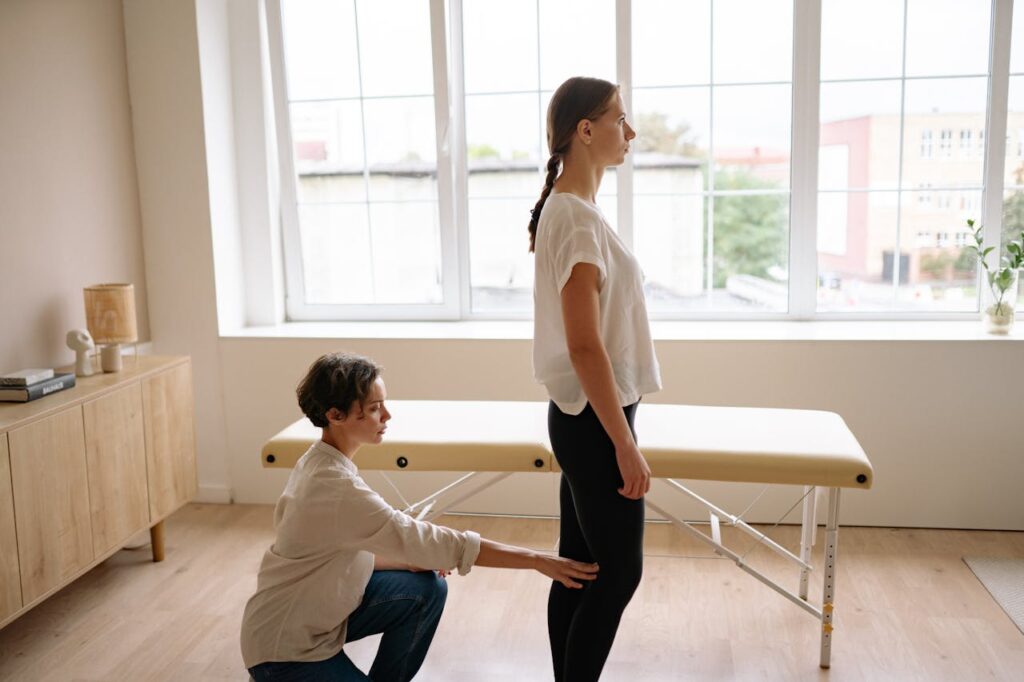
Think about the last time you felt genuinely confident and energized. Chances are, you were standing tall, shoulders back, and chest open. Research shows your posture plays a part in whether you’re perceived as submissive or dominant. Now, think about the last time you felt drained or defeated. Your body probably reflected that, too, curled inward, head dropped, and shoulders rounded. What most people miss is that the relationship runs both ways.
Your posture doesn’t just express your emotions. It actively shapes how you feel. Once you understand that connection, you have a powerful, always-available tool for steadying your mood and reclaiming your drive. This article walks you through the science, the three posture patterns most likely to work against you, and the practical corrections you can make starting today.
The Mind-Body Posture Connection: What Science Says
Every position you hold sends a signal inward. Scientists call this embodied cognition, the idea that the body and mind are in constant, real-time conversation. When you sit up straight, your brain receives a message that you are alert, capable, and ready. When you slouch, it has the opposite effect.
The science behind that signal is more concrete than you might expect. Researchers tested the connection between mood and posture directly, and their findings showed that students who walked in a slumped position reported significantly lower energy and more negative emotions than those who walked upright. Your posture, in other words, is not just a reflection of your internal state. It is an input.
3 Posture Patterns Worth Addressing
Posture problems rarely announce themselves all at once. Three patterns, in particular, develop gradually through daily habits, and each one quietly taxes your energy, breathing, and focus in different ways.
Forward Head Posture (FHP)
Forward head posture develops gradually when you spend hours in front of a screen or at a desk. Research on participants in a group with FHP found measurable differences compared to those without it, including the following:
- Reduced endurance in the neck extensor muscles
- Upper trapezius thickening
- Elevated neck pain and disability scores (NPDS)
- Greater functional neck disability (NDI))
If any of those findings sound familiar, you may already be dealing with FHP. The encouraging part is that targeted movement can begin reversing these patterns.
Anterior Pelvic Tilt
When the pelvis tips forward, the lower back over-arches. Anterior pelvic tilt compresses the lumbar spine and limits glute activation. When the glutes are underperforming, the hip flexors and lower back compensate by taking on the extra work. That added load creates a cycle of tightness and chronic discomfort in the hips and lower back.
Rounded Shoulders
Rounded shoulders close off the chest and restrict thoracic rotation, which is your ability to twist through the upper and mid back. This pattern also encourages mouth breathing over nasal breathing. Nasal breathing supports better oxygenation and a calmer nervous system, so the shift away from it carries real consequences for how alert and grounded you feel throughout the day.
How Posture Shapes Your Breathing and Your State of Mind
Each of those three posture patterns has a direct effect on how you breathe, which in turn shapes your entire physiological state. An upright spine creates room for full, diaphragmatic breathing, which activates the parasympathetic nervous system and moves the body toward calm, focused energy. Slouching compresses the diaphragm and promotes shallow chest breathing, which keeps the nervous system in a low-grade stress state.
The table below shows how those two breathing patterns differ across key markers of well-being:
| Deep Diaphragmatic Breathing | Shallow Chest Breathing | |
| Where It Originates | Belly and lower lungs | Upper chest only |
| Nervous System Effect | Activates parasympathetic (rest and digest) | Activates sympathetic (fight or flight) |
| Cortisol Levels | Lowers stress hormone production | Elevates stress hormone production |
| Heart Rate | Slows and regulates | Increases and destabilizes |
| Oxygen Intake | Full, efficient oxygenation | Reduced, inefficient oxygenation |
| Muscle Tension | Releases tension throughout the body | Maintains and increases tension |
| Mental Clarity | Improves focus and decision-making | Impairs concentration and recall |
| Mood | Promotes calm, stable emotions | Contributes to anxiety and irritability |
| Energy Levels | Sustained, steady energy | Fatigue and energy crashes |
| Posture Connection | Supported by an upright, open chest | Reinforced by slouching and rounded shoulders |
Research confirms that your breathing pattern and nervous system state are tightly linked, and your posture is what sets the foundation for both.
Posture also primes your motivation before effort even begins. Athletes use deliberate posture rituals before competition precisely because of this effect. Research shows that a structured posture ritual mobilizes motivation and emotional regulation, helping you prepare mentally before you even take a step. The same principle applies at your desk, in your warm-up, and at the start of any demanding task.
Posture Corrections You Can Start Today
A few targeted movements are enough to begin retraining your posture. According to Dr. Brandon Claflin at Oklahoma Interventional Spine & Pain, serving the Owasso area from the Tulsa clinic, small, consistent changes to daily habits are where lasting posture improvement begins.
- At your desk: Position your screen at eye level so your head stays neutral. Keep your feet flat on the floor and your hips at a 90-degree angle. Set a timer every 30 minutes to stand, roll your shoulders back, and take three slow, deep breaths before returning to your seat.
- In your warm-up: Before getting down to do your workout, add thoracic spine extensions over a foam roller and wall angels. Both movements address the three patterns above and reduce the compensations that creep into your form under load. Aim for two sets of 10 repetitions each before any session.
- In the gym: Intentional strength training is one of the most effective long-term posture interventions available. Rows, face pulls, glute bridges, and deadlifts all reinforce the posterior chain, the network of muscles along your back, glutes, and hamstrings that anchor upright posture every day. Program two to three of these movements per session for consistent results.
Overhauling your entire routine is not necessary to see results. Every rep and every mindful breath is a step toward the posture that carries you through your day.
Your Posture, Your Energy, Your Next Step
Posture and mood are not separate conversations. They are the same conversation, and it is happening in your body right now. The three patterns covered here, forward head posture, anterior pelvic tilt, and rounded shoulders, each chip away at the energy, clarity, and motivation you have available every day. Addressing them does not require a full lifestyle overhaul. It requires consistency with a handful of movements and a small amount of daily awareness.
Start here. Lift your chest, soften your jaw, and roll your shoulders back, letting them drop away from your ears. Take one slow breath from your belly. That is already something meaningful for your nervous system, and your brain is already receiving a new signal about what you are capable of.