
This interview is available in both English and French to honor Karen Gouaïda’s cultural roots and reach an international audience.
Cet entretien est disponible en anglais et en français afin d’honorer les racines culturelles de Karen Gouaïda et de le partager avec un public international.
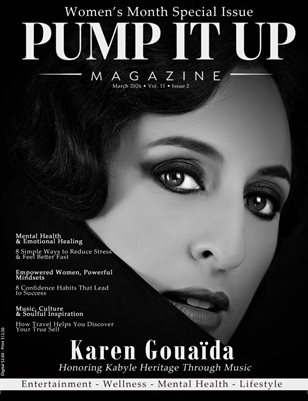
Pump It Up Magazine – March 2026 Cover Feature
By Anissa Sutton in Pump it up magazine
34 pages, published 3/14/2026

For our Women’s Month Special Issue, Pump It Up Magazine is proud to feature the inspiring artist Karen Gouaïda on the cover.
“As a Kabyle woman myself, hearing Karen sing ‘A Vava Inouva’ feels like hearing the voice of our shared memory — a reminder that our culture continues to live through every new generation.”
This interview holds a particularly meaningful place in my heart. Kabyle culture carries a deep tradition of storytelling, music, and resilience—values passed down through generations and kept alive through art.
Karen’s journey beautifully reflects this heritage. Born from a blend of Kabyle and French cultures, her music becomes a bridge between identity, memory, and modern expression. Through her interpretation of the legendary song “A Vava Inouva,” she continues a cultural legacy that has touched millions of hearts.
Beyond her artistry, Karen is also dedicated to teaching emotional intelligence to children, showing how creativity and empathy can shape a more compassionate world.
At Pump It Up Magazine, we believe music has the power to preserve heritage while bringing cultures together. Karen Gouaïda embodies that mission perfectly—honoring the past while inspiring the future.
It is a privilege to share her story with our readers.
Understanding Kabyle and Amazigh Heritage
For readers discovering this culture for the first time, the Kabyle people are part of the Amazigh (Berber) civilization, one of the oldest indigenous cultures of North Africa.
“The word Amazigh means ‘free people,’ and that spirit of freedom lives deeply within Kabyle music and storytelling.”
The word Amazigh itself carries a powerful meaning—it translates to “free people” or “free human beings.” Throughout history, Amazigh communities have preserved their language, traditions, music, and identity despite centuries of change and migration.
Kabyle culture, originating from the mountains of northern Algeria, is known for its rich traditions of poetry, storytelling, music, and strong community values.
Songs like the legendary “A Vava Inouva” by Idir became cultural landmarks, carrying the voice of a people, their memories, and their enduring spirit of freedom.
For artists like Karen Gouaïda, honoring Kabyle heritage is not only about preserving a tradition—it is about continuing the spirit of identity, resilience, and freedom that defines Amazigh culture.
As someone who also shares Kabyle roots, this cultural connection resonates deeply with me. It reminds us that music can keep history alive while bringing cultures together across the world.
— Anissa Sutton
Founder, Pump It Up Magazine
Cover Feature – Karen Gouaïda

Honoring Kabyle Heritage Through Music
“When my father heard ‘A Vava Inouva’ for the first time on the radio in Paris, he cried with pride. Today, when I sing it, I feel like I am continuing that moment of history.”
1. Karen, your heritage is a beautiful blend of Kabyle and French cultures. How did growing up between these two worlds shape your artistic sensitivity?
Growing up between two cultures is a bit like living between two landscapes.
On one side, there are the mountains and Kabyle heritage passed down by my father, with his songs and stories. On the other side, there is the French culture in which I grew up, which opened the door to many other artistic expressions.
Very early on, I understood that I didn’t have to choose between these two worlds. My artistic sensitivity was born precisely in that space between them—where roots meet the freedom to create.

2. Your father comes from the mountains of Greater Kabylia, a region rich in history and tradition. What family memories or stories have influenced you the most?
My father’s stories about the mountains of Greater Kabylia deeply nourished my imagination as a child.
He often spoke about life in the villages, the solidarity between families, and the importance of evening gatherings filled with songs and storytelling.
These stories described a simple yet profoundly human way of life, where relationships and cultural transmission played a central role. Even when living far from that land, those memories remain present and help shape our identity.
3. Kabyle culture has a strong tradition of passing down history through music and storytelling. When did you realize these roots were part of your artistic identity?
I believe this awareness came gradually.
As children, we experience these cultural elements naturally, without always understanding their depth.
As I grew older, I realized that those songs, sounds, and ways of telling stories were an integral part of my identity. They became a source of inspiration in the way I interpret music and convey emotion.
4. You chose to interpret the iconic song “A Vava Inouva” by the legendary Idir. What personal connection do you have with this song?
“A Vava Inouva” is deeply rooted in Kabyle collective memory. It evokes evening gatherings, stories told to children, and the gentle passing of traditions from one generation to the next.
I also have a very emotional connection to the song through my father.
When he first arrived in Paris, he worked in a department store while studying. One day he heard “A Vava Inouva” on the radio. It was the first time a Kabyle song had ever been broadcast in France.
He told me he cried with pride. For him, it felt as if a part of his homeland, his language, and his history had finally become visible.
When I sing this song today, I often think about that moment. It’s my way of continuing that emotion and honoring that memory.
5. What emotions did you hope to share with the audience through your interpretation?
Above all, I wanted to convey softness and nostalgia.
The song carries a very intimate and universal dimension connected to childhood, protection, and memory.
I wanted it to feel like a musical embrace—a suspended moment reminding listeners of their own memories.
6. Is it important for you to preserve and share this heritage through your music?
Yes, it is very important to me.
Music is one of the most powerful ways to keep a culture alive and pass it on.
Sharing these songs preserves memory while showing that traditions can evolve and continue touching new generations.
7. In addition to your artistic career, you teach emotional intelligence to children. How does that influence your musical expression?
Working with children has taught me the importance of authenticity and genuine emotion.
Children immediately feel whether an emotion is sincere or not.
In my music, I try to stay within that emotional truth—singing with simplicity, expressing authentic feelings, and creating a space where people can reconnect with their own emotions.
8. As a woman artist bridging tradition and modernity, what does it mean to use your voice to honor your roots?
Using my voice to honor my roots is a form of gratitude.
It’s not just about preserving a tradition, but allowing it to live in the present and resonate in a constantly evolving world.
If my voice can help create a bridge between the past and the present, that makes me deeply happy.
9. Many people are still discovering the richness of Kabyle culture. What message would you like to share through your music?
Kabyle culture is incredibly rich in human and poetic values.
It speaks about solidarity, family, dignity, and a deep connection to the land.
Through my music, I simply hope to invite people to discover the beauty, sensitivity, and depth of this heritage.
10. What does it mean for you to join The Sound of LA and collaborate with producer Michael B. Sutton?
Joining The Sound of LA and collaborating with Michael B. Sutton is both an honor and a valuable opportunity to share this music beyond borders.
Music has the unique power to bring cultures together and create unexpected connections.
Being able to carry this heritage in an international context is a beautiful way to show that traditions can travel and touch hearts everywhere.

Entretien avec Karen Gouaïda
Honorer l’héritage kabyle amazigh à travers la musique
(Traduction française de l’interview)
« Quand mon père a entendu “A Vava Inouva” pour la première fois à la radio à Paris, il a pleuré de fierté. Aujourd’hui, lorsque je la chante, j’ai l’impression de prolonger ce moment d’histoire. »
1. Karen, votre héritage est un magnifique mélange de cultures kabyles et françaises. Comment le fait d’avoir grandi entre ces deux univers a-t-il influencé votre sensibilité artistique ?
Grandir entre deux cultures, c’est un peu comme vivre entre deux paysages.
D’un côté, les montagnes et la mémoire kabyle transmises par mon père, avec ses chants et ses histoires. De l’autre, la culture française dans laquelle j’ai grandi et qui m’a ouvert d’autres formes d’expression artistique.
Très tôt, j’ai compris que je ne devais pas choisir entre ces deux mondes : ma sensibilité artistique est née justement dans cet espace entre les deux, là où les racines rencontrent la liberté de créer.

2. Votre père vient des montagnes de Grande Kabylie, une région riche en histoire et en traditions. Quels souvenirs ou récits familiaux vous ont le plus marquée ?
Les récits de mon père sur les montagnes de Grande Kabylie ont beaucoup nourri mon imaginaire d’enfant. Il racontait souvent la vie dans les villages, la solidarité entre les familles, la place importante des veillées, des chants et des histoires.
Ces récits évoquaient une vie simple mais profondément humaine, où les liens et la transmission occupaient une place essentielle. Même lorsque l’on vit loin de cette terre, ces histoires restent très présentes et contribuent à façonner notre identité.
3. La culture kabyle possède une grande tradition de transmission à travers la musique et les histoires. À quel moment avez-vous ressenti que ces racines faisaient partie de votre identité artistique ?
Je pense que cette prise de conscience est venue avec le temps. Enfant, on vit ces éléments de manière naturelle, sans toujours en mesurer la profondeur.
En grandissant, j’ai réalisé que ces chants, ces sonorités et cette manière de raconter le monde faisaient partie intégrante de mon identité. Ils sont devenus une source d’inspiration dans ma manière d’interpréter la musique et de transmettre des émotions.
4. Vous avez choisi d’interpréter la chanson emblématique “A Vava Inouva” du légendaire Idir. Quelle relation personnelle avez-vous avec cette chanson ?
“A Vava Inouva” est une chanson profondément ancrée dans la mémoire collective kabyle. Elle évoque les veillées, les histoires racontées aux enfants et cette transmission douce entre les générations.
J’ai aussi un souvenir très touchant lié à cette chanson à travers mon père. Lorsqu’il est arrivé à Paris, il travaillait dans un grand magasin pour payer ses études. Un jour, il a entendu “A Vava Inouva” à la radio. C’était la première fois qu’une chanson kabyle était diffusée en France.
Il m’a raconté qu’il en avait pleuré de fierté. Pour lui, c’était comme si une partie de sa terre, de sa langue et de son histoire devenait enfin visible.
Quand je chante cette chanson aujourd’hui, je pense souvent à ce moment-là. C’est une manière de prolonger cette émotion et de rendre hommage à cette mémoire.

5. Quelles émotions souhaitiez-vous transmettre au public à travers votre interprétation ?
À travers mon interprétation, j’ai souhaité transmettre avant tout de la douceur et de la nostalgie. Cette chanson porte une dimension très intime, presque universelle, autour de l’enfance, de la protection et du souvenir.
Je voulais qu’elle soit ressentie comme une caresse musicale, un moment suspendu qui rappelle à chacun ses propres souvenirs.
6. Est-il important pour vous de préserver et partager cet héritage à travers votre musique ?
Oui, c’est essentiel pour moi. La musique est l’un des moyens les plus puissants pour faire vivre une culture et la transmettre.
Partager ces chants, c’est préserver une mémoire, mais aussi montrer que les traditions peuvent continuer à évoluer et à toucher les générations d’aujourd’hui et de demain.
7. En plus de votre carrière artistique, vous enseignez l’intelligence émotionnelle aux enfants. Comment ce rôle influence-t-il votre expression musicale ?
Travailler avec les enfants m’a appris l’importance de l’authenticité et de l’émotion vraie. Les enfants ressentent immédiatement si une émotion est sincère ou non.
Dans ma musique, j’essaie de rester dans cette vérité émotionnelle : chanter avec simplicité, transmettre des sentiments authentiques et créer un espace où chacun peut se reconnecter à ses propres émotions.
8. En tant que femme artiste reliant tradition et modernité, que signifie pour vous utiliser votre voix pour honorer vos racines ?
Utiliser ma voix pour honorer mes racines est pour moi une forme de gratitude.
Il ne s’agit pas seulement de préserver une tradition, mais de la faire vivre dans le présent, de lui permettre de continuer à résonner dans un monde en constante évolution. Si ma voix peut contribuer à créer ce lien entre passé et présent, alors j’en suis profondément heureuse.
9. Beaucoup de personnes découvrent encore la richesse de la culture kabyle. Quel message aimeriez-vous transmettre à travers votre musique ?
La culture kabyle est une culture d’une grande richesse humaine et poétique. Elle parle de solidarité, de famille, de dignité et d’attachement à la terre.
À travers ma musique, j’aimerais simplement inviter les gens à découvrir cette beauté, cette sensibilité et cette profondeur qui font partie de cet héritage.
10. Que représente pour vous le fait de rejoindre The Sound of LA et de collaborer avec le producteur Michael B. Sutton ?
Rejoindre The Sound of LA et collaborer avec Michael B. Sutton représente un honneur et une opportunité précieuse de partager cette musique au-delà des frontières.
La musique a ce pouvoir unique de rassembler les cultures et de créer des rencontres inattendues. Pouvoir porter cet héritage dans un contexte international est pour moi une belle manière de montrer que les traditions peuvent voyager et toucher les cœurs partout dans le monde.–
Karen Gouaïda Duffour
Enseignante, art-thérapeute, auteure-illustratrice/Mini sentiers éditions
https://www.youtube.com/@karengouaida
https://www.instagram.com/karengouaida